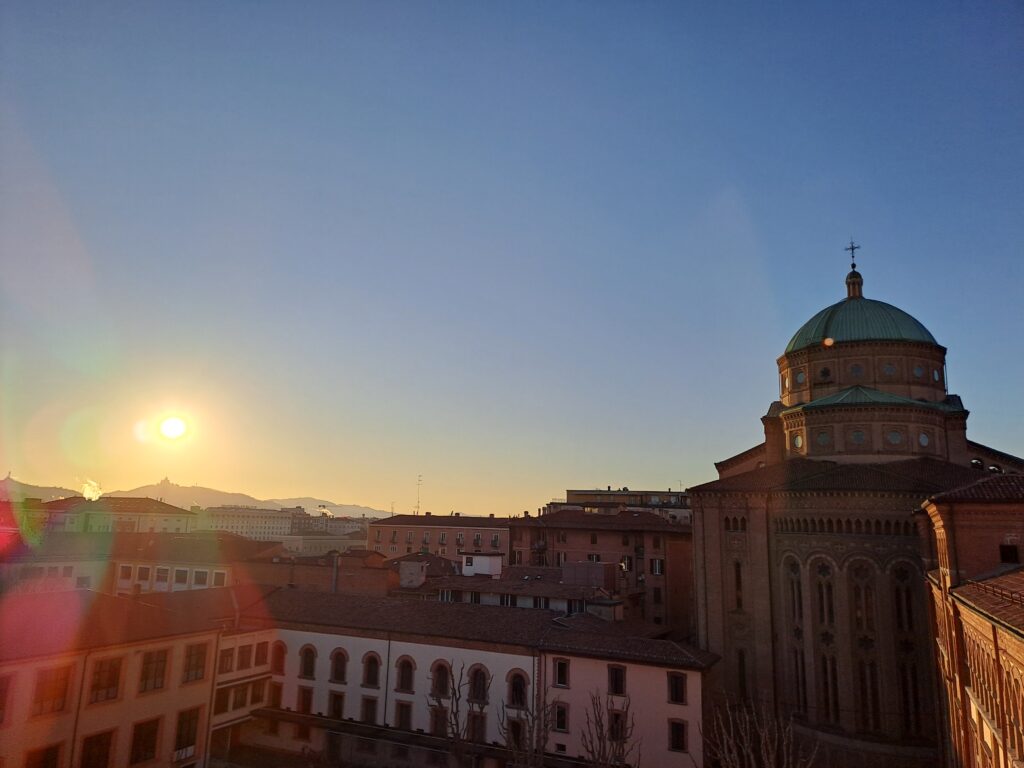
A Sanctuary in the Heart of the Neighborhood
Anyone arriving in Bologna by train and looking north sees, beyond the roofs of the Bolognina, a copper-clad octagonal dome. It is the Sanctuary of the Sacred Heart, one of the largest and most significant churches in the city, built in the early 20th century in a working-class and immigrant neighborhood that within a few decades would become one of Bologna’s most vibrant urban centers.
This is not a secluded or monumental place in the cold sense of the word. It is a church that has experienced the history of the 20th century firsthand—two reconstructions, the bombings of the war, a changing neighborhood—and which remains one of the city’s most active spiritual and community centers. Entering it means encountering art, history, and life together.
1. The Origins: The Salesians Arrive in Bologna
1895–1901
At the end of the 19th century, the area north of the train station was undergoing a complete transformation: fields and vineyards gave way to factories, workshops, and new working-class neighborhoods. It was a social frontier area, where problems related to employment and the new urban poverty were more acute than elsewhere.
It was Cardinal Domenico Svampa (1851–1907), Archbishop of Bologna, who envisioned a great church for this area that would be both a monument of faith and a symbol of hope for the people of Bologna. The idea took shape when the Salesians—the congregation founded by Don Bosco for the education of poor youth—settled in Bologna in 1896, opening a vocational school that the people of Bologna soon dubbed the “House of the Miracle” due to the rapidity with which it had sprung up.
Fundraising for the new church was extraordinary: Pope Leo XIII, Pius X, Count Giovanni Acquaderni, and many private individuals from across Italy contributed. The periodical “Il Secolo del Sacro Cuore,” promoted by the Cardinal himself, raised 250,000 lire in twelve years, more than half of the total construction costs. The foundation stone was blessed on June 14, 1901, in the presence of Don Michele Rua, Rector Major of the Salesians.
2. The Collamarini Temple
1901–1912
The project was entrusted to Edoardo Collamarini (1863–1928), one of the most active Bolognese architects of the time, responsible, among other works, for the Palazzo Bonora on Via Santo Stefano, the decoration of the Chapel of Sant’Anna in the Metropolitana, and the façade of Santa Maria delle Muratelle. Collamarini possessed the rare ability to blend different historical styles without the result appearing like a collage: the Sacred Heart is his most accomplished work.
The church blends Byzantine, Romanesque, and Gothic elements, all translated into Bolognese brick—a material capable of creating highly elegant decorative effects through its arrangement and color. The construction was supervised by engineer Luigi Reggiani; the master builder was Giovanni Donini, a renowned bricklayer. Both volunteered their services and were decorated by the Pope with the Commenda of San Gregorio Magno.
The sanctuary was consecrated on October 15, 1912, by Monsignor Giacomo Della Chiesa, Archbishop of Bologna—who would soon become Pope Benedict XV—and inaugurated the following day with a solemn ceremony. In 1912, the body of Cardinal Svampa, who died in 1907 without seeing his dream come true, was buried in the crypt.
3. A Troubled History
1912–1947
The life of the sanctuary was not straightforward. Don Riccardo Zucchi, the first full-time parish priest, was a priest of great dedication, beloved especially by the humblest of the neighborhood. His death in 1929 left a profound void—but that same year brought an even greater misfortune.
On November 21, 1929, in the early afternoon, the majestic dome that Collamarini had raised to the sky collapsed with a crash, taking with it the floor and part of the sides. A huge roar, a cloud of dust, the church gutted. Miraculously, there were no casualties: the chaplain, Father Luigi Montuschi, alerted to suspicious creaking sounds, had ushered the faithful out a few minutes earlier.
The causes were multiple: the soft alluvial soil, the inadequate foundations, the thin mortar used in construction, the earthquakes of that year. The community fell into despair, but Cardinal Nasalli Rocca was clear: the church had to be rebuilt “where and how it was.”
The task was entrusted to Father Antonio Gavinelli, a Salesian renowned as a skilled church builder, who arrived in Bologna in May 1930. Gavinelli consolidated the foundations with a ring of reinforced concrete, rebuilt the four pillars of the dome in concrete, and re-erected the entire structure. The work—commissioned by the Fratelli Castelli company of Milan—lasted until 1934. On January 24, 1934, the restored dome was blessed; the sanctuary solemnly reopened on May 19, 1935, the day Bologna celebrated the canonization of Don Bosco, which had taken place in Rome on April 1, 1934.
On September 25, 1943, new bombs hit the Salesian Institute and destroyed the church’s façade. Father Gavinelli, arrested that same year and confined to L’Aquila (a leaflet in the parish bulletin had been deemed anti-fascist), returned after the war and resumed restoration work. In 1947, the sanctuary was once again completed. Father Gavinelli died in 1968 and rests in the crypt next to Cardinal Svampa, the two men who, more than any other, built and maintained this place.
4. The Architecture: Looking at the Church
Anyone who looks at the Sacred Heart immediately realizes that it is more beautiful from the side than from the front: the true development of the building lies in its depth, with the dome dominating the central core and the two semi-domes flanking it. From the exterior, the concentric plan structure is evident: the rhythmic arches, the window tracery, the cordoning, all in a Byzantine tradition filtered through Romanesque and Gothic sensibilities, translated into Bolognese brick.
The façade, with a single-cusped gable, is divided into three sections by four sturdy pilasters. At the bottom is the large portal with four rows of columns and a large archivolt; the lunette features a polychrome mosaic of the Sacred Heart, donated by Monsignor Della Chiesa. Above the portal is a large window with lateral mullioned windows and a rose window; above is an airy loggia with trefoil arches. The sides repeat the same motifs: ten mullioned windows per side, five for each tier, all with elegant fretwork and stained glass windows.
The interior is both grandiose and austere. The church measures 52 meters long and 29 meters wide; the central nave is 45 meters long and 14 meters wide. What is immediately striking is the vertical thrust of the pillars and the expert distribution of light: the dome brings light from above, the stained glass windows diffuse it laterally. The walls are bare brick—no frescoes—and the contrast between the red brick and the pale plaster creates a strikingly sober effect. The octagonal dome, sixty meters high, is visible from all elevated points in the city.
5. Art Treasures
The Stained Glass Windows
The collection of 134 stained glass windows is one of the largest and most unified in Italy. The earliest—those in the apse—date to 1934; the others were created starting in 1937, all based on cartoons by Professor Antonio Maria Nardi, by the Pritoni glassworks using the traditional high-fire method. Damaged by bombing, they were restored by February 1948. Nardi’s preparatory cartoons, preserved by the heirs, were acquired by the parish in 2015. The windows depict saints and blesseds associated with Bologna, the Salesian Congregation, and devotion to the Sacred Heart.
The Stations of the Cross
The fourteen carved and polychromed wooden stations that adorn the side walls are the work of Antonio Mussner of Ortisei (Val Gardena), inaugurated in April 1936. The fine carving and vibrant polychrome make it one of the most accomplished wooden cycles of 20th-century Italian art.
The High Altar
At the center of the presbytery stands the large marble aedicule designed by architect Federico Rampazzini, inaugurated on June 23, 1938. The central niche houses the carved and polychromed wooden statue of the Sacred Heart, created by Antonio Mussner based on a design by Milanese sculptor Angelo Ferreri. The elegant marble inlay floor of the presbytery recalls the Cosmatesque floors of Roman basilicas; it was restored in 1950.
The Side Chapels
Four chapels flank the nave. On the left: the Chapel of the Holy Family with the altarpiece by Alessandro Franchi di Prato (1905); and the Chapel of San Giovanni Bosco with the marble altar designed by Collamarini and the large altarpiece by Augusto Maiani (1937). On the right: the Chapel of San Giuseppe with the Transit of Saint Joseph by Renato Pasqui (1951); and the Chapel of the Blessed Virgin of the Rosary with a copy of the famous Madonna by Sassoferrato.
The Baptistery
Located to the left of the entrance, it houses the octagonal baptismal font in polychrome marble and a fresco of the Baptism of Christ, one of Renato Pasqui’s early works.
The Wooden Crucifix
In the small choir to the left of the presbytery is a carved and patinated wooden crucifix by an unknown artist, attributed to the 16th or 17th century. For its expressive power and stylistic vigor, it is a work of considerable merit, resembling Guido Reni’s Crucifix in the Galleria Estense in Modena.
The Organ
Located in the choir loft above the main door, it is the work of the Fratelli Ruffatti company of Padua (1955): three manuals, five thousand pipes, and fifty-five real registers. It is one of the largest modern organs in Bologna, blessed on June 19, 1955, by Cardinal Giacomo Lercaro.
6. The Crypt
Beneath the presbytery lies the crypt, inaugurated in 1903 and open for worship since 1905. The space consisted of three parts: the central nave and two side chapels, soberly decorated with frescoes by Renato Pasqui.
At the center, in the arcosolium of the Good Shepherd, is the tomb of Cardinal Domenico Svampa. The marble urn is the work of Edoardo Collamarini and recalls classical sarcophagi; the arcosolium is lined with marble and mosaics from the Venetian Mosaic Society; the stained-glass window depicting Christ holding the lamb is the work of the Beltrami firm of Milan (1912). Beside the Cardinal rests Don Antonio Gavinelli, the priest who twice rebuilt the sanctuary.
The sanctuary’s valuable reliquaries, a collection of considerable historical and devotional interest, are displayed along the walls. Originally, there were three marble altars (1940), dedicated to the Blessed Virgin Help of Christians (center), Saint Dominic Savio (right), and Saint John Bosco (left). Now only the central marble altar remains.
7. The meaning of a sanctuary: the Sacred Heart and the Eucharist
Why a church dedicated to the Sacred Heart of Jesus? Devotion to the Heart of Christ has ancient roots in Christian spirituality, but it spread widely starting in the 17th century, when the Visitandine Saint Margaret Mary Alacoque (1647–1690) reported visions in which Christ asked that his pierced heart be honored as a symbol of God’s infinite love for humanity.
The connection to the Eucharist is no coincidence: the Gospel of John recounts that blood and water flowed from the side of the crucified Jesus (John 19:34), which have always been interpreted as symbols of Baptism and the Eucharist—the two sacraments that generate and nourish the life of the Church. Contemplating the Sacred Heart therefore means contemplating the person of Christ incarnate in the light of His boundless love.
This shrine arose in a working-class neighborhood, among hard-working people who needed a concrete and tenacious faith. The Sacred Heart, with its immediate and powerful image, responded to that need.
8. The Decorations and the Eucharistic Decennials
One of the most vivid traditions linked to the Sacred Heart is that of the Addobbi: a medieval Bolognese custom that consists of adorning the neighborhood streets with drapes, flowers, and lights during Eucharistic celebrations. Documented as early as the 15th century and revived by Archbishop Paleotti in the 16th century, this tradition has remained alive around the sanctuary with particular intensity.
In 1927, on the occasion of the first Eucharistic Decennial, the decorations became an event of extraordinary popular participation. Since then, they have been repeated every ten years: ten celebrations in total, from the first in 1927 to the tenth in 2017. Each Decennial involves the entire neighborhood for months: the streets are transformed, the community gathers around its church.
One of the most precious objects preserved in the sanctuary dates back to the first Decennial in 1927: the Tovaglia delle Promesse, a large piece of Aemilia Ars lace—the Bolognese embroidery technique of Renaissance tradition—donated by the students of the Salesian Institute’s Women’s Work School. The school taught embroidery, sewing, and tailoring to over a hundred students a day. The tablecloth, of rare finesse, is embroidered with the twelve promises of the Sacred Heart of Jesus.
9. A Living Community: Yesterday and Today
The Shrine of the Sacred Heart has never been just a building to be admired: it has always been, first and foremost, a community. Over time, a network of activities has developed around the church and the Salesian Institute, shaping the life of the neighborhood.
One of the most significant initiatives was the Bollettino del Sacro Cuore: born as a parish newspaper, it became one of the most widely distributed Catholic publications in Italy during the twentieth century, growing from an initial circulation of 350,000 copies to over a million after the war, with 220,000 families subscribing throughout the country.
10. The Shrine Today: Restorations and New Signs
On July 4, 2011, the Ministry of Cultural Heritage recognized the Shrine of the Sacred Heart as a site of historical and artistic interest. Since that year, systematic restoration work has been underway, involving the dome, apses, side chapels, the baptistery, and the chapel of the Holy Family.
In 2015, the parish acquired from the heirs the preparatory cartoons for the stained-glass windows created by Professor Antonio Maria Nardi—an artistic treasure of considerable documentary importance for the history of 20th-century Italian sacred art.
On June 1, 2014, the Piazzetta Don Gavinelli, in front of the sanctuary, was inaugurated with a bronze statue of the great rebuilder. The work of sculptor Luigi Enzo Mattei was the first bronze statue to be installed on a public street in Bologna in decades. In May 2017, the same sculptor created the Memorial dedicated to the history of the sanctuary. In March 2017, the Shroud of Turin Crucifix, a reproduction of Christ’s face taken from the image on the Shroud of Turin, was placed in the church.
Practical information
The Shrine of the Sacred Heart is located at Via Giacomo Matteotti, 27, Bologna, near the central train station. It can be reached by several city bus lines and, starting in 2027, by the new tram line.
The crypt is accessible via the side steps of the presbytery.
For information on Mass schedules, guided tours, and parish activities: www.sacrocuorebologna.it